Table of contents
Recruitment platforms are using AI to screen candidates. Employee engagement tools are using AI to analyze survey comments. Learning platforms are using AI to recommend training. HR chatbots are answering employee questions. Workforce planning tools are helping leaders model future hiring needs. With all these tools, you would think that teams would have learned AI literacy.
The problem is not that HR teams are ignoring AI.
The problem is that many HR teams are using AI without fully understanding how it works, where it helps, and where it can create risk.
This creates a new kind of HR skill gap.
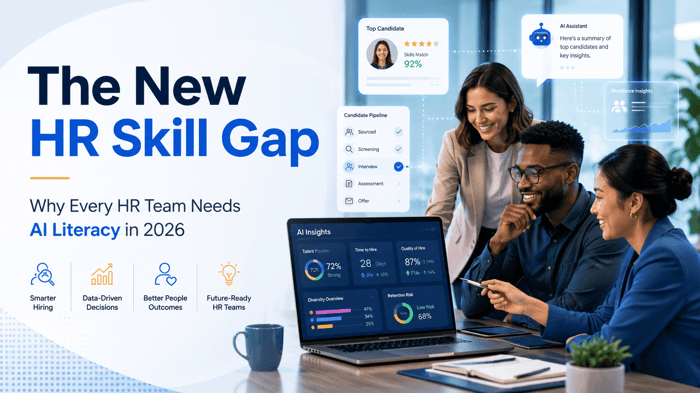
In the past, HR teams needed to understand employment law, people management, culture, compensation, recruitment, and employee relations. Those skills still matter. But now HR also needs a new capability: AI literacy.
AI literacy does not mean every HR professional needs to become a data scientist or engineer. It means HR teams need enough understanding to use AI responsibly, ask better questions, challenge vendor claims, explain decisions, and protect candidates and employees from poor automation.
In 2026, AI literacy will become one of the most important skills in HR.
What AI Literacy Means in HR
AI literacy in HR is the ability to understand, evaluate, and use AI tools in a practical and responsible way.
It includes knowing what AI can do, what it cannot do, and what kind of human oversight is needed.
For HR teams, AI literacy means being able to answer questions like:
| Question | Why it matters |
|---|---|
| What data does this AI tool use? | Poor data can lead to poor recommendations |
| How does the tool make recommendations? | HR needs explainability, not blind trust |
| What decisions should humans still own? | Accountability cannot be outsourced to software |
| How could bias appear in this process? | AI can reduce bias, but it can also repeat it |
| How will candidates or employees experience this? | Efficiency should not damage trust |
| What should we measure after launch? | AI tools need monitoring, not just setup |
AI literacy is not about becoming technical for its own sake.
It is about becoming a better buyer, user, and manager of AI systems.
An HR team with low AI literacy may buy a tool because it sounds impressive. An HR team with high AI literacy will ask what problem the tool solves, how it reaches its outputs, how results are reviewed, and whether the tool improves the experience for people.
That difference matters.
Why HR Cannot Leave AI to IT Alone
Many organizations treat AI as a technology issue.
That is a mistake.
AI in HR is not just a technical decision. It is a human decision.
IT can help assess security, integrations, system performance, and technical implementation. Legal can help review compliance and risk. Procurement can compare vendors and contracts.
But HR needs to understand the human impact.
When AI is used in hiring, performance management, employee listening, or workforce planning, it affects real people. It can influence who gets interviewed, who gets hired, who gets promoted, who receives support, and who is flagged as a risk.
That means HR cannot simply hand the decision to another department.
HR needs to be involved in questions such as:
| AI use case | HR’s responsibility |
|---|---|
| AI candidate screening | Ensure evaluation is job-related and fair |
| AI interview scoring | Review whether scoring criteria reflect real role needs |
| AI engagement analysis | Interpret employee sentiment with context |
| AI performance review support | Make sure feedback remains specific, fair, and human |
| AI workforce planning | Challenge assumptions behind forecasts |
| HR chatbots | Ensure answers are accurate, clear, and employee-friendly |
AI literacy gives HR the confidence to sit at the table with IT, legal, finance, and leadership.
Without it, HR risks becoming a passive user of tools that shape major people decisions.
The Risk of Using AI Without Understanding It
AI can make HR faster.
But faster is not always better.
A poorly understood AI tool can create several problems.
First, it can create false confidence. If a platform gives a candidate a score, recruiters may assume the score is more objective than it really is. But every score depends on the data, criteria, and design choices behind the system.
Second, it can create hidden bias. AI tools can reflect patterns from past data. If past hiring decisions were biased, inconsistent, or based on narrow definitions of success, the AI may repeat those patterns unless the system is carefully designed and monitored.
Third, it can damage candidate and employee trust. People are more accepting of AI when they understand how it is being used and when they know humans remain accountable. If AI feels secretive, cold, or unfair, it can hurt the employer brand.
Fourth, it can produce more data without better decisions. Many HR tools generate dashboards, scores, summaries, and recommendations. But if the team does not know how to interpret them, AI simply creates a new layer of noise.
This is why AI literacy matters.
The goal is not to reject AI. The goal is to use it with enough understanding to get the benefits without creating unnecessary risk.
The Core AI Skills HR Teams Need
HR teams do not need to learn how to build AI models.
But they do need practical AI skills.
The first skill is problem definition.
Before choosing a tool, HR should be able to define the actual problem. Is the issue too many CVs? Too many phone screens? Slow scheduling? Poor candidate quality? Inconsistent interview feedback? High employee turnover? A vague AI project usually leads to vague results.
The second skill is prompting and workflow design.
Even simple AI tools work better when HR teams give clear instructions. A strong prompt includes context, criteria, desired format, and constraints. For example, asking AI to “write interview questions” is weak. Asking AI to “create five competency-based interview questions for a junior sales role, focused on resilience, communication, and objection handling” is much stronger.
The third skill is AI output review.
HR teams need to know how to check AI-generated content. This includes reviewing whether outputs are accurate, fair, relevant, and aligned with company standards. AI should not be copy-pasted into sensitive HR processes without review.
The fourth skill is bias awareness.
HR professionals need to understand how bias can enter AI systems. Bias can come from historical data, poorly chosen criteria, vague scoring rubrics, or inconsistent human review. AI literacy helps HR ask where bias might appear and how it will be monitored.
The fifth skill is explainability.
HR teams should be able to explain how AI is used in a process. This does not mean explaining the full technical model. It means being able to say what the tool evaluates, what it does not evaluate, how humans review the output, and how decisions are made.
The sixth skill is change management.
AI adoption often fails because people do not trust the tool or understand how to use it. HR needs to train recruiters, managers, employees, and leadership on what the AI tool is for, how to use it, and what boundaries exist.
How HR Leaders Can Build AI Literacy
The best way to build AI literacy is not through one long training session.
It should be built through practical use.
HR leaders can start by choosing one clear workflow where AI can help. Recruitment is often a strong starting point because many tasks are repetitive and measurable. For example, teams can test AI for CV summaries, interview guide creation, candidate screening, or recruiter note generation.
Then the team should review the results together.
Did the AI save time?
Were the outputs useful?
Did recruiters trust the recommendations?
Did candidates have a better experience?
Were any mistakes or risks identified?
This turns AI literacy from theory into practice.
HR teams can also create simple internal guidelines.
These guidelines do not need to be complicated. They should answer basic questions:
| Guideline area | Example rule |
|---|---|
| Human oversight | AI can recommend, but humans own final decisions |
| Sensitive data | Do not upload confidential employee data into unapproved tools |
| Candidate communication | Be transparent when AI is used in the hiring process |
| Output review | AI-generated HR content must be checked before use |
| Tool approval | Only approved AI tools should be used for HR workflows |
Small rules can prevent large problems.
Where Lantern AI Fits Into This Shift
One area where AI literacy matters most is recruitment screening.
Traditional hiring processes often rely on manual phone screens, inconsistent notes, and subjective first impressions. Recruiters may ask different questions to different candidates, making it harder to compare people fairly.
Lantern AI helps HR teams bring more structure and consistency to the screening stage.
Lantern conducts real-time conversational AI interviews, asks role-relevant follow-up questions, and gives recruiters structured summaries and scoring. Instead of replacing recruiter judgment, it gives hiring teams clearer evidence to review.
This is a strong example of AI being used in the right way: automating repetitive screening work while keeping humans responsible for hiring decisions.
For HR teams building AI literacy, tools like Lantern also help create a practical learning opportunity. Recruiters can see how AI gathers information, how summaries are created, and how structured evaluation improves decision quality.
The result is not just faster hiring.
It is a more informed, more consistent, and more transparent hiring process.
Check out Lantern AI HERE
Conclusion: AI Literacy Is Becoming an HR Advantage
AI will not replace HR teams.
But HR teams that understand AI will move faster than those that do not.
They will choose better tools. They will ask better vendor questions. They will design safer workflows. They will explain AI decisions more clearly. They will protect candidate and employee trust while still improving efficiency.
The future of HR belongs to teams that can combine human judgment with intelligent systems.
That starts with AI literacy.
Not technical perfection. Not a complicated theory. Just a practical understanding of where AI helps, where it needs oversight, and where humans must stay in control.
In 2026, the strongest HR teams will not be the ones using AI everywhere.
They will be the ones who understand how to use AI well.