Table of contents
The New Application Economy: What Recruiters Need to Know Right Now
The rules of hiring haven't been rewritten, but they're being stress-tested in ways most HR teams weren't prepared for. Online applications still dominate. Referrals still convert best. Sourcing is up. And AI is now on both sides of the hiring desk. The Glassdoor data released in January gives us the clearest picture yet of how these forces are playing out, as well as what to do about them.
World of Online Applications
Online applications remain the single most powerful channel for job seekers. In 2025, they led to 2 times as many interviews and 1.5 times as many job offers as all other sources, referrals, recruiters, staffing agencies, and in-person applications combined, according to Glassdoor. In concrete terms, online applications accounted for 66% of all interviews and 60% of all job offers reported on Glassdoor in 2025.
But the dominance is slipping, and the reversal is sharper than most teams realize. The share of interviews starting with online applications climbed steadily from 53% in 2012 to a peak of 76% in 2023. Then it dropped to 75% in 2024, and fell another 9 percentage points to 66% in 2025. Job offers show a similar decline, falling from a high of 73% in 2023 to 60% in 2025. That brings both figures back to roughly 2018 levels, erasing nearly a decade of growth in two years. As Glassdoor put it: "This is a sharp reversal from the growing dominance of online applications from their high in 2023, but they still account for the strong majority of interviews and job offers. With the recent drop, the share of applicants returned to roughly 2018 levels."
Recruiters, on the other hand, face a separate set of problems, notably that online applications have removed enough friction that it is more difficult to identify good candidates in a bigger pool of options, Glassdoor said. In answer, many have focused on sourcing candidates on their own.
Recruiters are also turning to AI tools to sort through candidates amid higher pressure to fill roles, LinkedIn said, particularly as demand for specific skills increases.
What the Data Really Tells Recruiters — And What to Do About It
The Glassdoor findings paint a picture that is both reassuring and urgent. Online applications are not dying, but the way candidates find opportunities, and the way recruiters find candidates, is shifting faster than most HR teams are prepared for.
The share of interviews starting with online applications peaked at 76% in 2023, then dropped to 66% in 2025, a reversal that brings the numbers back to roughly 2018 levels. That decade-long climb has stalled, and the question for every recruiter is: what filled the gap?
The answer is proactive sourcing. Glassdoor explains it plainly: "The size of the haystack they have to search through is larger, and it’s harder to distinguish the needle from the hay as the overall quality of resumes and cover letters has increased," meaning that sourcing at scale comes with its own problems. As more candidates apply online with little friction, recruiters are simultaneously drowning in volume while struggling to find quality. Teams using AI analytics are 2.1 times more likely to meet hiring service-level agreements, which explains why so many are turning to AI tools not to replace their judgment, but to make it faster and more consistent.
Referrals: High Value, Low Volume
Referrals remain the most efficient path to a hire, but they're hard to scale. Employer referral programs have historically struggled with communication, experts previously told HR Dive. And the Glassdoor data shows referral interviews are 35% more likely to convert to a job offer than online applications, yet they account for just 10.2% of offers. The math is compelling, but the execution is where most programs fall apart.
Glassdoor clearly notes the structural ceiling: "While employee referrals have a lot to offer, there are some drawbacks (e.g., less diverse applicant pools) and limitations, so there's an upper limit on how much companies should rely on a referral program."
Experts point to overly complex reward structures, poor internal communication, and a failure to articulate what a good referral actually looks like. Fixing this doesn't require a new tool; it requires clarity. Who are you looking for? What does a strong referral look like? What happens after someone refers a candidate?
To answer these questions, you need to analyze your process, not your technology.
The AI Arms Race on Both Sides of the Application
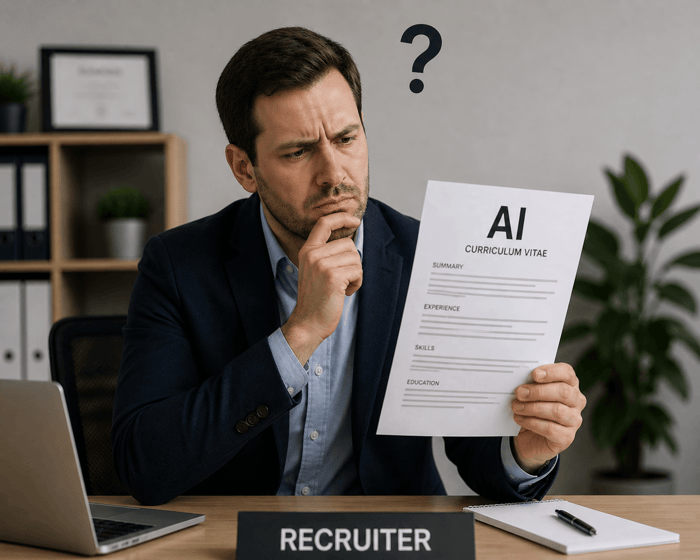
Here's what makes the current moment particularly complex: candidates are also using AI. By mid-2025, 40.7% of candidates reported using AI in their job search, down from less than half that just a year earlier. AI-written resumes increased screening workload, with 64% of recruiters seeing more look-alike applications. The result is a paradox: AI is making it easier to apply and harder to stand out, simultaneously.
For recruiters, this makes the screening stage more critical than ever. Volume is up, signal is down, and the pressure to quickly identify a genuine fit has never been higher.
But the AI arms race also has a candidate experience dimension that often gets overlooked. When every resume sounds the same, and every cover letter hits the same notes, the things that actually differentiate a candidate (specific experience, demonstrated judgment, cultural alignment) get buried. Recruiters who design their process to surface those signals (through structured screens, skills-based assessments, or better intake questions) will find better candidates faster than those relying on resume review alone.
What this means for recruiters in 2026
The teams pulling ahead aren't the ones working harder; they're the ones who have built smarter systems. Online applications still win on volume and offer rate. But winning the application game in 2026 means having infrastructure behind it that filters signal from noise before a human ever gets involved.
The shift from 2023 to 2025 happened quietly. Application share dropped 10 points. Sourcing nearly doubled. AI entered the candidate toolkit at scale. Most HR teams noticed these trends individually but didn't redesign their processes to account for all of them together.
That's the real opportunity heading into 2026: not chasing the next channel or tool, but building a hiring system coherent enough to work across them all.
Key Takeaways and Recommended Steps
- Audit your application process for friction. Long forms, broken mobile flows, and slow response times cost you qualified candidates before they ever finish applying.
- Build sourcing pipelines before roles open. Don't wait for a vacancy to start identifying candidates in high-demand skill areas; by then, you're already behind.
- Use AI to triage volume, not replace judgment. Teams using AI analytics are 2.1x more likely to meet hiring SLAs. The goal is a faster signal, not automated decisions.
- Simplify your referral program. One clear incentive, communicated widely, with a closed feedback loop. Referral interviews are 35% more likely to convert to an offer. Most programs underperform because of process, not interest.
- Add a skills-based screen early in the funnel. With 64% of recruiters seeing more look-alike AI-written resumes, a single well-designed question separates genuine fit from polished formatting.
- Track source-of-hire data quarterly. The shift from 76% to 66% online application share happened in two years. Waiting for annual reviews means you're always reacting, never anticipating.
TL;DR
Online applications still drive the majority of interviews (66%) and job offers (60%), but their dominance has dropped sharply from a 2023 peak, erasing nearly a decade of growth in just two years. Recruiter sourcing is up 72% since 2023 to fill the gap, while referrals remain the highest-converting channel but hardest to scale. AI has tripled application volume per role, making screening the make-or-break stage of the funnel. The recruiters winning in 2026 aren't working harder; they're building smarter systems that filter signal from noise before a human ever gets involved.
Drowning in Applications? Lantern Can Help.
If the screening bottleneck is where your hiring stalls, Lantern was built for exactly this moment.
Lantern is a conversational AI hiring platform that replaces phone screening with human-like AI interviews — running 24/7, scoring and ranking candidates automatically, and delivering ready-to-review summaries so your team can skip the inbox chaos entirely.
In a world where application volume has tripled, and look-alike resumes are everywhere, Lantern gives you the signal back. Set up in 1 minute. Integrates with 30+ ATS platforms. No learning curve.
Data source: Glassdoor Economic Research, based on analysis of 1.24 million interview reviews from January 2012 through July 2025.
FAQs
Are online job applications still worth it in 2026?
Yes! And by a wide margin as well. Online applications still account for 66% of all interviews and 60% of all job offers, AND they generate 2x as many interviews as all other sources combined. Still an incredibly reliable way to apply.